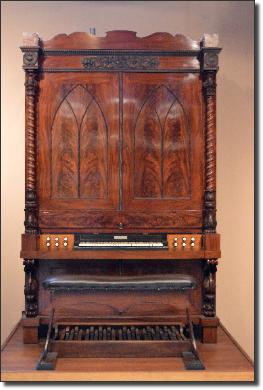
For sale: lovely salon organ
built in 1844 by the organ builders Kam and Van der Meulen.
Description.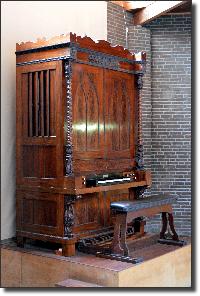 Salon organ with one manual and attached pedal, in completely closed case with original swell mechanism.
Precious furniture piece, designed in a free classicistic form.
Oak posts and rails, veneered in Cuban mahogany and decorated with ripple moldings. In the sides of the upper case are the vertical shutters of the swell mechanism. Panels and shutters are of solid Cuban mahogany. In the lower case on both sides of the manual there are beautifully carved Cuban mahogany brackets with curls, in which a swan is embedded. At the corners of the upper case are lovely twisted columns of Cuban mahogany, ending in decorative capitals topped by cartouches. In the frieze is a mascaron with fanning vines, at the top is a carved fronton.
Original disposition:
Manual C-f''' |
 |
|
|
||
|
|
|
|
|
|
1. |
|
Salicionaal |
8' |
|
(probably) |
2. |
|
Holpijp |
8' |
|
bass and treble |
3. |
|
Octaaf |
4' |
|
bass and treble |
4. |
|
Fluit |
4' |
|
|
5. |
|
Octaaf |
2' |
|
|
6. |
|
Dulciaan |
8' |
|
bass and treble; free reed |
Pedal (C-c’) attached
tremulant
exhaust valve
swell
pitch: a' = 440 Hz.
History.
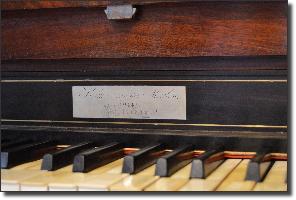
The organ was built in 1844 by the organ builders Willem Hendrik Kam (1806-1863) and Hendrik van der Meulen (1810-1852). The original location is not known.
Kam and Van der Meulen are among the most important Dutch organ builders of the 19th century. The company was established in 1837 in Rotterdam. Kam and Van der Meulen developed an original style, based on local traditions and an internationally oriented scientific approach.
 In 1903 the organ was placed in the church of Fort Blauwkapel (near Utrecht) by the organ builder J.C. Sanders of Utrecht. It had come from Amsterdam. When placing the instrument in Blauwkapel (or perhaps later), Sanders replaced the 8’ Salicionaal, and also possibly the top octave of the 8’ Holpijp and the 2’ Octaaf. Following further work by Sanders in 1923 and 1932, the organ was dismantled and stored in 1943 to protect it from possible war damage. In 1966 it was placed in the Jeruzalemkerk (Troosterlaan) in Utrecht. Possibly at that time the bass octave of the 8’ Holpijp was provided with Westaflex conductors. It is possible that the top octave of the 8’ Holpijp and the 2’ Octaaf were replaced at this time. In 1976 the organ was placed in the Gereformeerde kerk ‘De Hoeksteen’ in Vianen by the organ builder J. Brink of Nieuwegein, who changed the free-reed 8’ Dulciaan into a beating reed. In 1985, Brink reconstructed Sanders’s top octave of the 8’ Holpijp and the 2’ Octaaf.
In 2007 the organ was restored by organ builder Henk van Eeken of Herwijnen, with Peter van Dijk of Utrecht as consultant. The work was acompanied by drs. Wim Diepenhorst for the National Service for Archaeology, Cultural Landscape and Built Heritage (RACM). The historically evolved condition of the instrument was respected. The case was restored and reconstructed together with restorer Geert Hardeman of Leersum. All the work was carried out with historically correct materials, in historically correct detailing, and with historically correct methods of treatment. The pipework was repaired in its current state. The pumping mechanism was reconstructed.
Characterization.
Typical 19th-century salon organ from the early period of the builders Kam and Van der Meulen.
Historical value.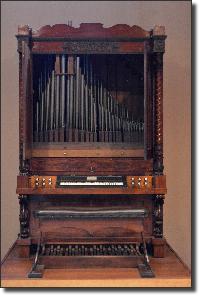 The following parts are from 1844:
the case;
the wind system;
the wind chest;
the manual;
the pedal keyboard;
the key action and the stop action;
202 of the 312 pipes.
Dimensions. |
|
|
|
|
Maximum height |
: |
2,85 |
|
meter |
Width |
: |
1,77 |
|
meter |
Depth of the upper case |
: |
0,85 |
|
meter |
Maximum depth of the lower case |
: |
1,07 |
|
meter |
Price.
The organ is for sale for an attractive price.
For information please contact us via: info@henkvaneeken.com
© Photo's: dr. B.G. van Buitenen.